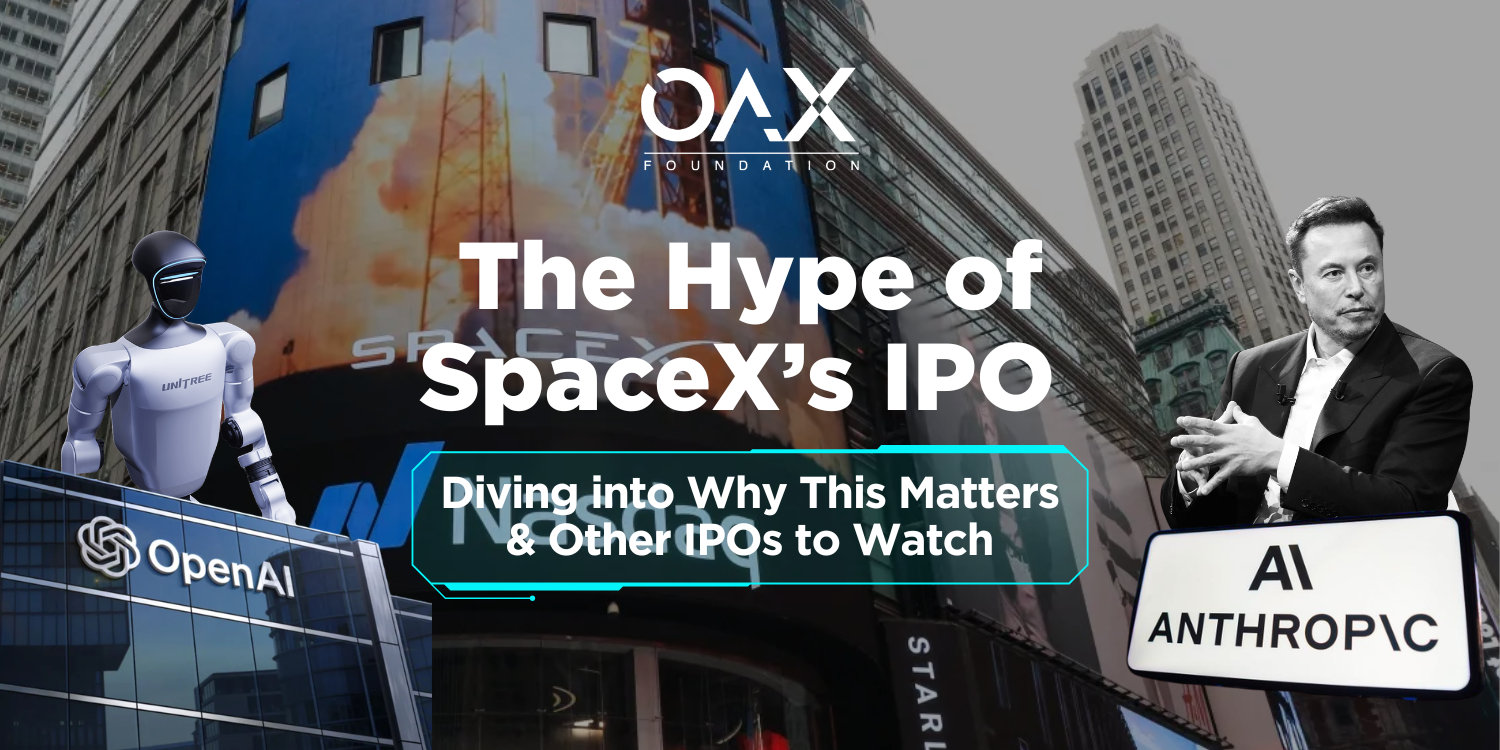
Not Rockets, Rent: The Real Story Behind the Biggest IPO in History
How does SpaceX, a rocket company, become one of the most important names in artificial intelligence, before sending anything into space? Last week, SpaceX raised US$75 billion in the largest stock listing ever. It has not put a single AI data center in orbit. Not one. Yet it is already collecting around US$1.25 billion a month in rent for AI computing, from a rival it once mocked. The answer to the biggest market debut in history is not rockets. It is rent.
The headline everyone saw
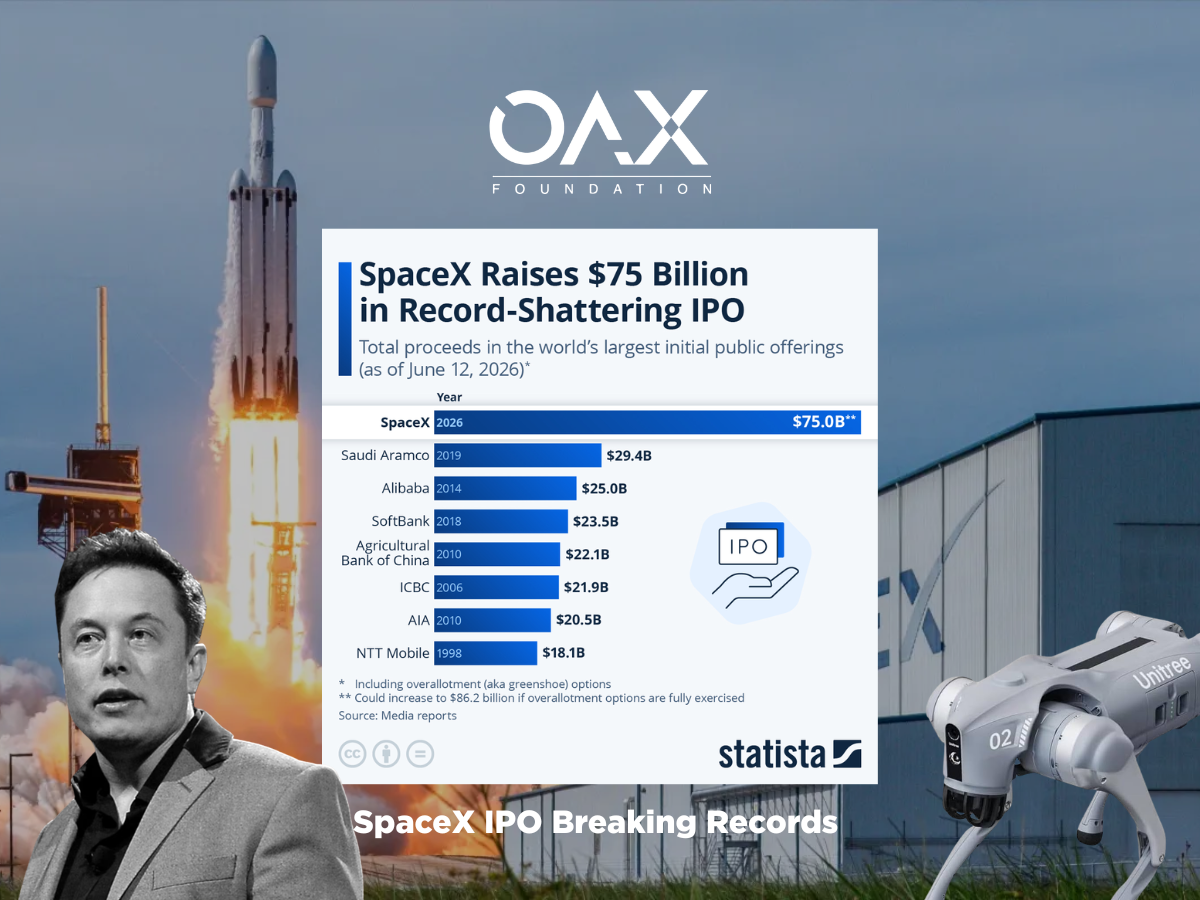
On 12 June, SpaceX sold shares to the public for the first time. It raised US$75 billion, the largest IPO ever, and the stock jumped 19% on its first day, lifting the company above US$2 trillion and making Musk the world’s first trillionaire.
Most headlines called it a space story. We think they missed the real one.
It’s not a space stock. It’s an infrastructure play.
SpaceX makes rockets and runs Starlink, its satellite internet service. But the engine behind this IPO is AI, just not in the way you might expect.
Last year, Musk merged SpaceX with his AI company, xAI, maker of the Grok chatbot, in a deal that valued the combined company at $1.25 trillion. Grok was meant to challenge ChatGPT and Claude. It lost badly, the AI unit lost $2.5 billion in a single quarter on just $818 million of revenue. So Musk changed the game. Instead of fighting to build the best AI, he became the landlord who rents out the ground all AI is built on: computing power.
Here is the key idea. Every AI company, OpenAI, Anthropic, Google, needs huge amounts of “compute”: warehouses full of specialised chips (called GPUs) that train and run AI models. These warehouses are called data centers, and building them is slow and costly. Compute is the scarce resource of this era. xAI had built a giant data center in Memphis for Grok. After Grok failed, those chips were sitting almost idle, running at around 11% of capacity. So Musk rented the near-empty building to his rivals. Anthropic now pays about $1.25 billion a month, Google about $920 million, together roughly $26 billion a year. The companies racing to win AI now pay Musk for the land they stand on.
Musk has always been obsessed with power
This instinct is not new. Musk’s whole career circles one thing: energy.
Tesla is remembered as a car company, but its first mission was energy. It built home batteries (Powerwall), giant grid batteries (Megapack), and bought a solar company. The cars were the entry point; controlling how power is made and stored was the goal.
AI’s biggest bottleneck today is not chips , it is electricity. Building large data centers on Earth is getting harder because of power supply, water for cooling, land, and permits. In Memphis, xAI ran gas turbines that worsened local pollution and drew protests. So Musk is doing what he always does, taken to the extreme.
The bet: move the data centers to space
Days before the IPO, SpaceX revealed “AI1,” a plan to put data centers in orbit. The logic is bold but simple. In space, sunlight is free and constant, no power bills, no grid. Heat escapes into the vacuum, no water for cooling. There is no land to buy and no permits to fight over. On Earth, data-center electricity costs $85 to $140 per unit; in orbit the energy is essentially free, you only pay to build and launch the equipment.
Notice what this requires: rockets, satellites built at scale, and space-grade power systems. That is exactly what SpaceX already does, and what no AI software company can copy. The advantage is not clever code. It is hard engineering.
Beyond Musk: What it means for Anthropic and OpenAI
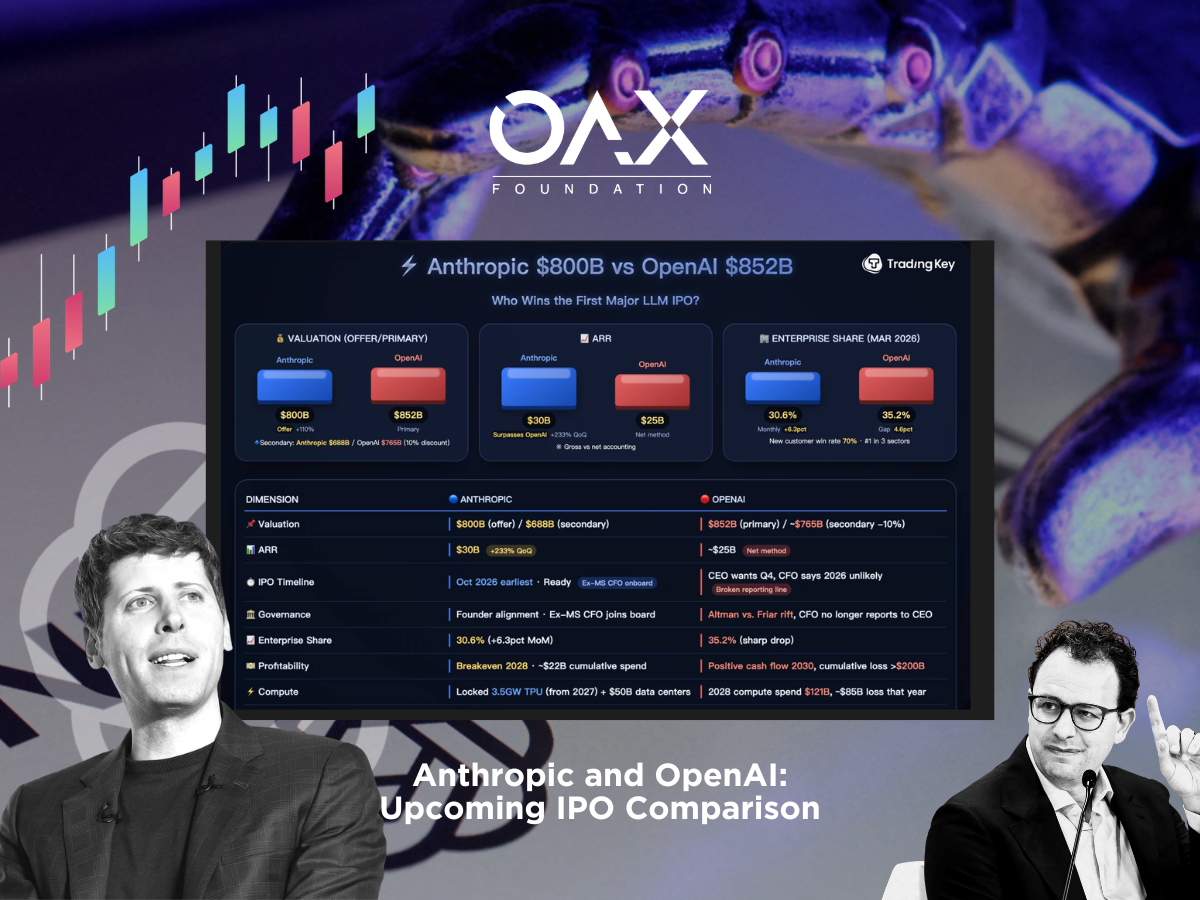
SpaceX is only the first of a wave and its debut changed the game for the others. Anthropic filed to go public on 1 June, OpenAI on 8 June, and together the three are worth roughly $3.6 trillion. SpaceX’s listing pressures both of them in two ways.
First, it set a price. The market has now valued a loss-making AI-and-space giant at more than $2 trillion, giving Anthropic and OpenAI a live benchmark they must measure up to.
Second, it soaked up money. Analysts warn the three listings together could pull over $200 billion out of the market, nearly as much as the entire dotcom boom raised. That is why Anthropic and OpenAI are filing quickly, before investors run low on appetite.
Anthropic and OpenAI hold the one thing SpaceX tried to build and lost, the AI that people and companies actually use, with Anthropic already at a $30 billion-plus run-rate and OpenAI reaching around 910 million weekly users, plus the enterprise lock-in and consumer reach Grok never managed. And crucially, neither depends on Musk: both are pouring hundreds of billions into their own compute. For the first time, the public including investors here in Asia will get to judge AI’s real numbers, not just the marketing.
Not everyone is convinced
The first day was strong, but not euphoric, and it reopened a bigger argument: is the entire AI boom a bubble? The sharpest warning is about price. The research firm Morningstar values SpaceX closer to $63 a share, less than half the $135 listing price, and the stock trades at roughly 60 times its sales, richer than the peaks of the 2021 tech bubble, for a company that lost nearly $5 billion last year.
There are quieter warning signs too: Musk insisted on a short rental contract with Anthropic and reserved the right to take the compute back, not how a company behaves when it is confident the demand will last. And the timing is delicate.
The listing landed the same week US inflation hit 4.2%, a three-year high, just before a central bank meeting where rates might rise rather than fall, the kind of backdrop that punishes expensive, profit-light stocks hardest. So what would failure actually look like? Probably not a rocket exploding. The likelier danger is that the rent dries up. Google is only renting as a temporary “bridge” while it builds its own capacity; Anthropic has its own enormous deals with Amazon and Google coming online from 2027.
If the AI building frenzy cools, or those tenants simply move into the data centers they are constructing themselves, the rent shrinks, while the orbital dream is still years and many billions away from filling the gap. That, not a launchpad disaster, is the real risk to watch.
The thread home
Here is what struck us most. In the same month SpaceX’s space-and-AI empire went public in New York, In China, Hong Kong sent its first astronaut into orbit. Lai Ka-ying, a police superintendent with a doctorate in computer science, reached China’s Tiangong space station for a six-month mission. Space, AI, and compute are no longer distant American stories. They are regional and personal. The real question for Hong Kong is whether a proud moment becomes a lasting pipeline of talent and ideas.
The lesson
The headline was a record IPO. The real story is an infrastructure play, a bet that whoever controls power and compute controls the AI era. The first test satellites are planned for early 2027, and orbital data centers at real scale are not expected until the late 2020s or early 2030s. Today’s $2 trillion price already asks you to pay for a future that has not arrived.
Then, just four days after the listing, SpaceX announced it would buy Cursor, one of the most popular AI tools for writing software code for $60 billion, paid entirely in its newly minted shares. After losing the chatbot race with Grok, Musk is using his new public stock to buy his way into the one AI application already making real money proof the listing was about firepower for big moves, not just raising cash.
But there is a deeper lesson worth holding onto. Grok was supposed to win the chatbot race. It didn’t. Many builders would have called that a failure and walked away. Musk did something smarter: he kept the core bet, own the infrastructure of the AI era, and simply changed the role of what he had built. The data center stopped being a tool to train his own model and became a business renting compute to everyone, even his rivals. The plan did not change. The role did.
From OAX Foundation’s perspective, it is the mindset this era rewards. When a product does not play out the way you intended, you do not abandon the mission, you find the next, larger problem your assets can solve. Keep innovating, stay close to your core, let the role evolve. The most valuable companies of this decade may not be the ones with the cleverest chatbot, but the ones solving the unglamorous, enormous problems underneath: energy, cooling, launch, and scale. That is where the biggest opportunities, and the deepest local roots, will be.
Disclaimer: The above is an opinion piece written by an authorized author, but in no way represents the official standpoint of OAX Foundation Limited, nor should it be meant to serve as investment advice.