The AI Job Divide: What Happens When AI Can Do More of Your Work?
Imagine a familiar request from your manager: pull together the latest figures, update the report, and have it ready before the afternoon meeting. You know which systems to check, which numbers need explaining, and how much time the formatting will take.
Now imagine your manager can ask an AI for the report directly.
That is the proposition behind Linnovate’s newly launched RAISE AI, featured in GMAsia’s news coverage. Announced in November, the tool lets investment professionals request reports and dashboards in plain language, drawing on data within its platform. These are the company’s stated capabilities, rather than evidence of jobs being eliminated. But they raise a very human question: if producing that report is a substantial part of your working day, what happens next?
Perhaps you get more time to investigate what the numbers mean. Perhaps your manager expects twice as many reports. Perhaps the team decides it no longer needs another junior hire.
The same tool could lead to each of those outcomes. The difference lies in how the employer chooses to use it.
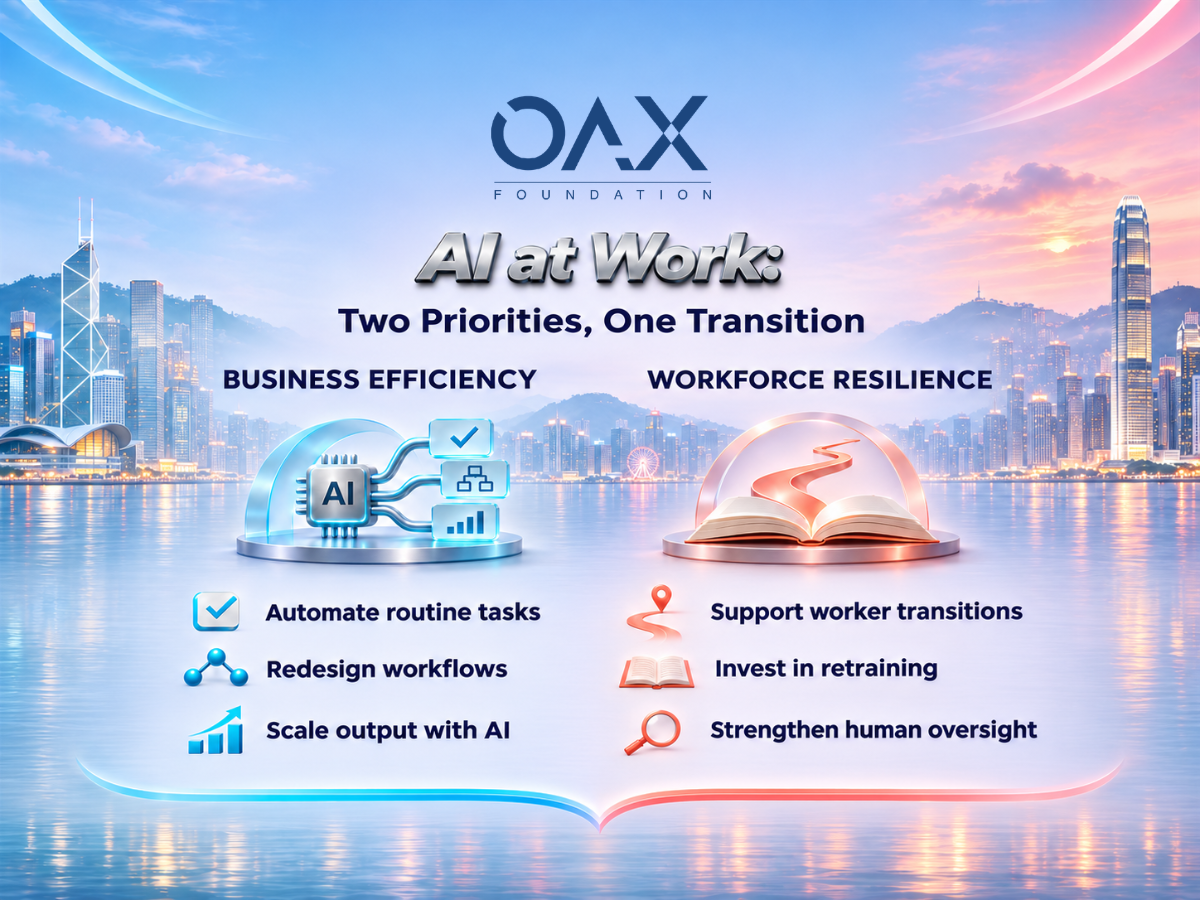
Business Efficiency and Workforce Resilience
That leaves businesses with two responsibilities: finding where AI can improve their operations, and helping employees prepare for the work that remains or emerges.
A report produced in seconds still needs someone who can spot a misleading number, explain an unexpected result, and take responsibility for the recommendation. Employees need opportunities to develop those skills alongside learning the software.
So, what are employers actually doing?
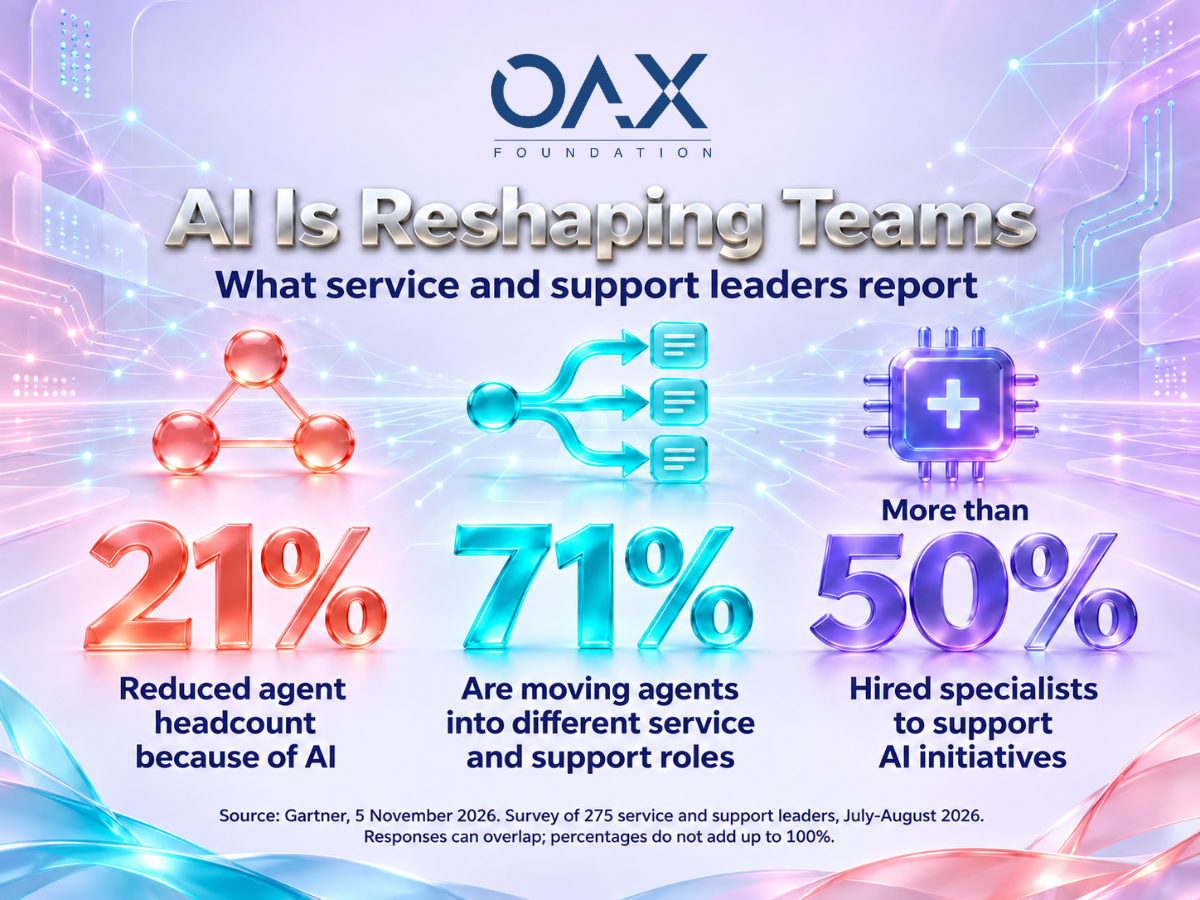
A Gartner survey published on 5 November offers a more complicated picture than the familiar prediction of mass replacement. Among 275 service and support leaders surveyed in July and August 2026, 21% said their organisations had reduced human-agent headcount because of AI. Meanwhile, 71% reported moving human agents into different roles within service and support, and more than half had hired specialists to support AI initiatives.
These responses can overlap: a business can cut some roles while hiring or redeploying people elsewhere. They describe changes reported by leaders, rather than the proportion of jobs lost or workers moved.
For an employee, “your role is changing” can be almost as unsettling as “your role is disappearing.” What will the new responsibilities involve? Will training happen during working hours? Will the change create a better opportunity, or simply add more work?
Three Layers of Change: Your Tasks, Your Team, Your Organisation
To understand what that transition might look like, it helps to consider three layers of change. These can overlap and develop at different speeds; they are possibilities, rather than a fixed timetable.
First, the tasks within your job change. AI helps draft an email, search documents, prepare a report, or answer a routine enquiry. Your job title may stay the same, while the way you spend your day shifts.
The immediate question is what happens to the time saved. Does it go towards solving harder problems, serving more customers, or taking on additional assignments? For the worker, those are very different versions of “greater productivity.”
Second, the team’s workflow changes. Instead of helping with one task, AI connects several activities: collecting information, preparing an output, routing it for review, and following up. Responsibilities and handovers may change as a result.
Imagine a customer-service team where AI handles straightforward enquiries. The people remaining on the phones could spend more of their day dealing with disputes, exceptions, and distressed customers. Their work may demand more judgement and emotional skill, even if the total number of calls falls. Training and performance expectations would need to reflect that.
Third, the organisation makes bigger choices. Once AI changes what a team can deliver, employers may reconsider recruitment, management responsibilities, services, or team size. Some may use the additional capacity to grow. Others may seek lower costs.
A product demonstration cannot tell us which choice an employer will make. Nor does successful automation of one activity prove that an entire department can operate with fewer people.
If AI Does the Basic Work, How Do New Employees Learn?
There is a useful example of a different workforce strategy in Singapore. In October, UOB announced plans to hire 1,000 young graduates annually while preparing its workforce for greater AI adoption. It also introduced a programme to train 5,500 managers using an AI-enabled coaching platform and expanded flexible work opportunities for experienced professionals. These are announced plans, but they show that investing in AI and recruiting people can form part of the same strategy. Read the story on GMAsia.
That raises a question employers cannot afford to skip: if AI handles more of the basic work, how will new employees gain experience?
Preparing a report teaches you where the data comes from. Answering customer enquiries teaches you which problems recur. Checking calculations teaches you how mistakes happen.
Automating those activities may save time, but newcomers still need to build that understanding. Asking a junior employee to “check the AI’s work” is only useful if they have been taught how to recognise a problem.
Employers will need to think about supervised practice, mentoring, and how responsibility develops. Otherwise, they risk removing the work through which people learn while continuing to expect experienced judgement from them.
What Does Worker Protection Look Like in Practice?
Governments face a similar challenge at a larger scale. China’s employment guidelines, released in October, address both AI’s potential to create work and the disruption it may cause. They cover employment-risk assessments, transition support, skills development, and worker protections, alongside measures to encourage new opportunities.
Four themes in those guidelines help make the policy discussion more concrete:
-
Assess the impact before deployment. The guidelines call for employment-risk assessments in relevant AI applications, including assessments during reviews of market-access projects likely to cause substantial employment disruption.
-
Give workers time and support to transition. Companies are encouraged to explore transition buffers, notify affected workers, and provide support for moving into other employment or roles.
-
Build skills for the work ahead. Training and vocational pathways should help workers develop capabilities relevant to changing demand.
-
Protect people as working arrangements change. Worker protections and oversight of algorithmic management matter alongside the introduction of new technology.
These themes are useful, but an announcement is only the beginning. For someone affected, the practical questions remain: is there an actual role to move into? Is the training relevant? Does the new position offer comparable pay and prospects?
“Retraining” sounds reassuring until someone has to fit it around a full-time job, family responsibilities, and the possibility of losing their income.
The challenge also goes beyond a simple East–West divide. Businesses need productivity, experienced staff, and future talent. Governments want growth as well as employment. The difficult part is making those ambitions work together for the people going through the transition.
What You Can Do With the Work in Front of You
For individuals, a useful starting point is to examine the work they already do.
Take that recurring report. An AI might help assemble it, but someone must establish whether the information is complete, explain an unexpected result, and decide what action follows. Learning to operate the tool and learning to question its output belong together.
A practical experiment could begin with a low-risk task, using approved tools and permitted data. Compare the result with your usual work. Record what saves time, what needs correcting, and which decisions still require your knowledge. This gives you concrete evidence to discuss with your manager: where the technology helps, what responsibility you could take on, and what support you would need.
For some professionals, AI may also make independent work more manageable by helping with administration, research, or preparing materials. But building a business still requires customers, trust, and reliable delivery. It is one possible route, with its own risks, rather than an automatic answer to displacement.
The Opportunity After Automation
For OAX Foundation, these developments make practical AI education increasingly relevant. Useful learning goes beyond prompts to include checking outputs, understanding limitations, and deciding where automation belongs in a real workflow. GMAsia’s coverage connects those questions to the choices businesses across the region are making, while the GMAsia Campus provides meaningful AI courses so workers can upskill themselves.
Linnovate’s launch shows the kind of work technology providers are seeking to automate. UOB’s plans show that employers can also invest in recruitment and development as AI advances. The wider outcome depends on how those decisions come together.
When AI takes over part of the work, what opportunity will the person doing it have next?
That is a question employers should be able to answer before asking their people to embrace the change.
Disclaimer: The above is an opinion piece written by an authorized author, but in no way represents the official standpoint of OAX Foundation Limited, nor should it be meant to serve as investment advice.