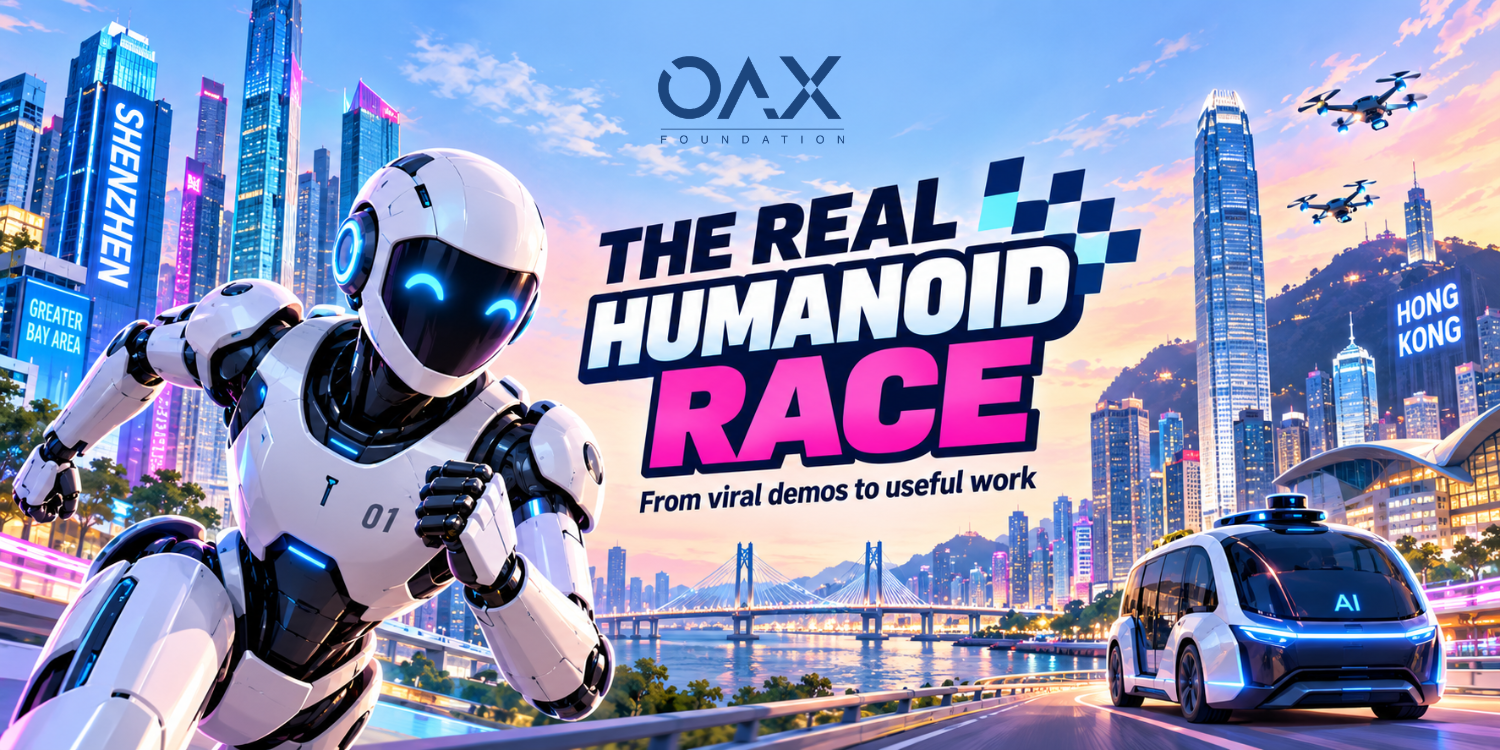
Robots Can Dance. Can They Work?
Robots can now kick, dance, run and backflip. But at this time, that doesn’t mean they can do your laundry or other real, useful work.
The humanoid videos filling social feeds in 2026 are extraordinary feats of engineering. But they also make it easy to confuse athletic ability with useful intelligence.
We feel that the real test of a robot is much less glamorous.
Can it unload a dishwasher without breaking a glass? Fold clothes it has never seen before? Work an eight-hour shift without stopping for human help?
That is where the humanoid race gets interesting.
The industry is moving from “Can we make robots move like humans?” to a much harder question: “Can we make them useful in the real world?”
And that shift has major implications for AI, manufacturing… and particularly for China and the Greater Bay Area.
What The Videos Don’t Show You
While consumer imagination is naturally captured by the dream of a household robot maid, indeed a market worth trillions but the reality is that household utility remains the hardest frontier.
The industry currently faces three fundamental roadblocks: Hardware & Manipulation (how affordable, how well can it move), Edge Compute & Chips (powering heavy models locally without draining battery fast), and Capital & Unit Economics (scaling initial production runs before ROI is proven).
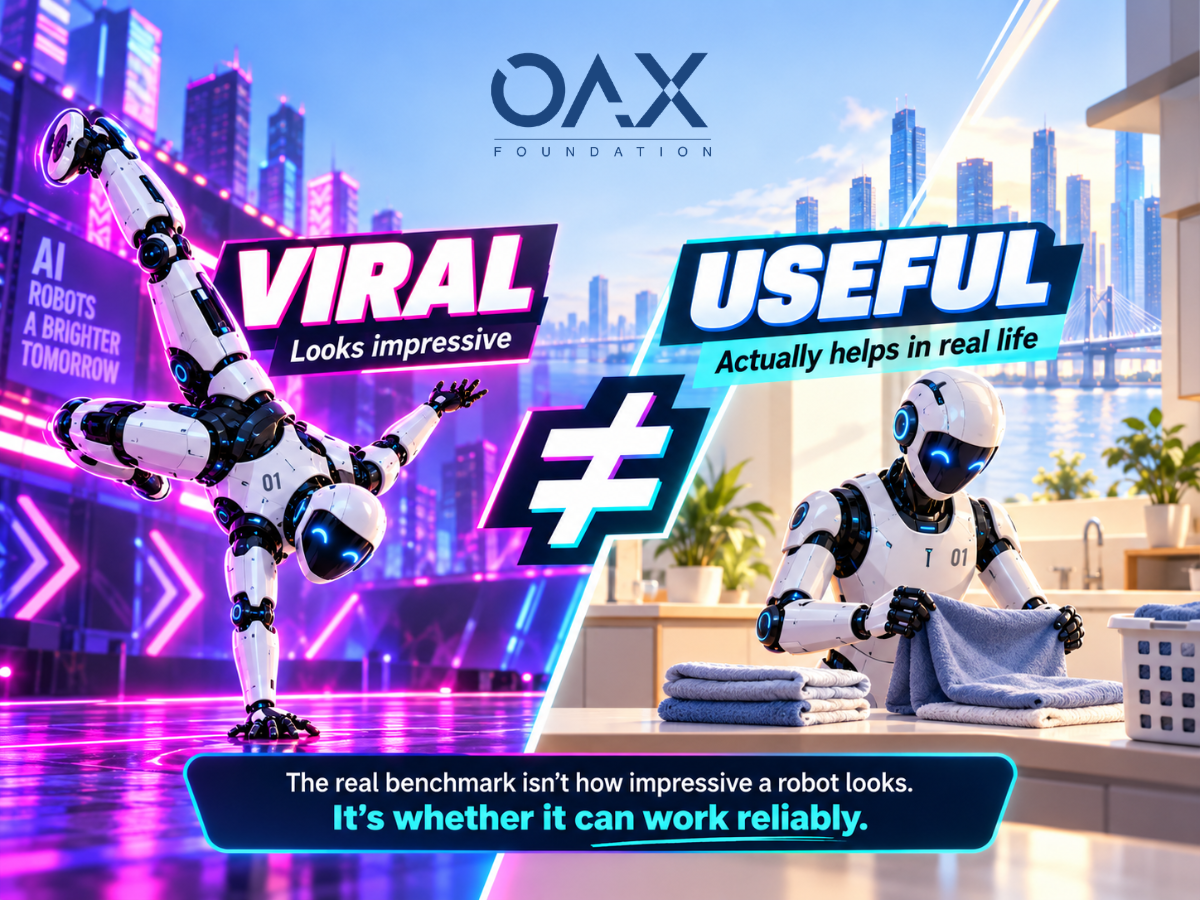
It is easy to watch these clips and assume general-purpose robots are on the cusp of doing our grocery shopping. However, viral video clips are tailored to highlight only balance and motor power - and that is only one facet on what makes a robot useful.
When roboticists evaluate whether a humanoid is genuinely useful, they don’t look for athletic gymnastics like dancing, martial arts or backflips.
They ask simple questions like these: Can it unload a dishwasher without cracking a wine glass? Can it fold a pile of mismatched, wrinkled laundry? Can it operate continuously for an eight-hour shift without crashing or needing human intervention?
Because these are the scenarios that can actually help our day to day work.
Why Human Hands Are Still an Engineering Nightmare
Human hands feature lots of ways to move, packed with tens of thousands of tactile receptors. They effortlessly adjust grip pressure on the fly, holding a fragile egg, turning a rusty doorknob, or applying heavy torque with a wrench.
Building a mechanical hand that matches human sensitivity while remaining affordable, compact, and durable enough to withstand millions of continuous impacts remains one of hardware engineering’s greatest hurdles.
Most robotic hands on the market today are either too rigid to handle delicate items or too delicate and expensive to survive long industrial shifts that can actually be useful to the situations above.
The motor dense robotic hand that combines human-level sensitivity with industrial longevity at a sub $5,000 price point refers to the first Hardware Challenge.
Factories First, Homes Later
Companies like Tesla, Figure AI, BMW, and Hyundai are deploying early humanoid fleets into automotive assembly lines rather than selling them directly to consumers because these environments are predictable.
The Industrial Proving Ground (Structured):
A factory floor is an engineered space, with known layouts, dealing with repeatable objects in predictable sequences. The actions of the robots can be “pre-programmed” on it’s action or rely on Human Teleoperation. This is where ROI is clear and environments are controlled. Players like Tesla (Optimus), Figure AI, Agility Robotics, UBTECH, and Unitree are deploying here first to solve basic utility without real life unpredictability.
Many of the most impressive viral clips showing delicate manipulation (shirt folding, making coffee) actually rely on a human operator standing behind the scenes wearing a VR headset and motion-tracking gloves.
The Household Horizon (Unstructured):
Consumer interest is massive, but why moving from a clean warehouse floor to a clutter-filled living room requires a 10x leap in real-time spatial reasoning and safety guarantees. Because in contrast to a factory, an average family home is full of hazards like children, pets, toys, loose cables, and slippery rugs.
There is an infinite amount of variation that happens in an unpredictable environment like, chairs move, doors open and shut, and shadows shift throughout the day.
This cannot be “pre-programmed” but instead requires the robot to have the intelligence to improvise and it needs a ton of training data. Bridging this gap is where software development is focused today. On top of dual-track (factory and household) giant companies mentioned above, 1X Technology’s NEO is an OpenAI backed household specific humanoid with features that are much home family from the get go.
LLMs had the internet. Robots don’t.
Chatbots can learn from billions of pages of text. A humanoid has to learn what happens when a glass slips, a drawer jams or a shirt folds differently every time.
That means robot companies have to manufacture their own experience - in simulation, through human teleoperation and eventually through real-world deployment.
Today, the industry relies on a three-part training pipeline:
- Simulation (“Robot Gyms”): Engineers build digital virtual environments, where thousands of simulated robots run, fall, and learn balance at 100x speed.
- Teleoperation: Think of remote control cars. There’s a human operators wear VR headsets and motion-tracking gloves to remotely guide physical robots through real-world tasks (folding shirts, picking bolts).
- Real-World Foundation Models (VLAs): AI models that turn camera images and spoken words directly into physical movement. Like how an autonomous vehicle works to read the road situation by studying lots of images.
China’s Humanoid Advantage Isn’t Just AI - It’s Manufacturing
While Western firms lead in foundation AI models, China has developed a formidable hardware and deployment flywheel.
-
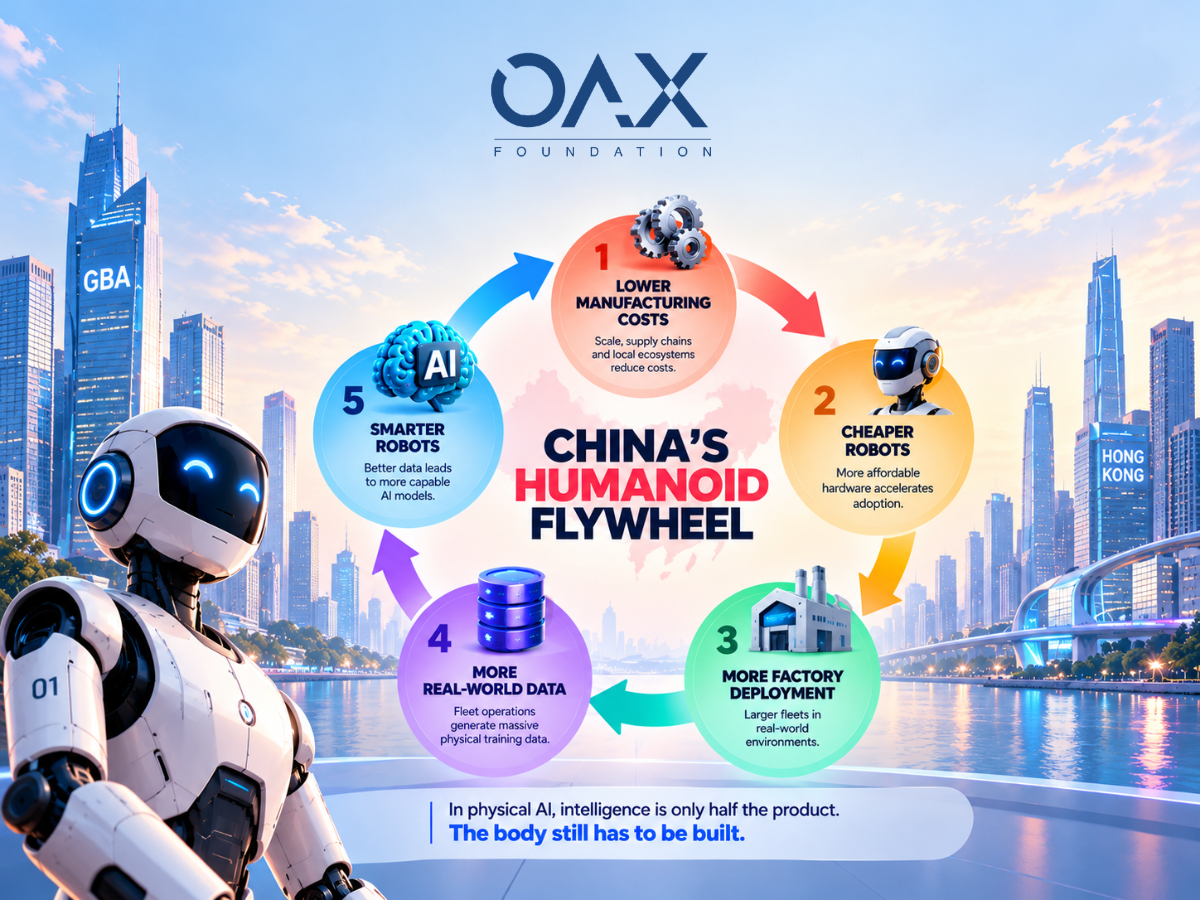
Supply Chain Proximity: Industrial hubs in Shenzhen and the Yangtze River Delta allow hardware startups to prototype, manufacture, and iterate joint motors, gears, and battery systems at significantly lower costs.
-
The Data Flywheel: Lower manufacturing costs mean cheaper robots. Cheaper robots lead to larger fleet deployments in factories. Larger fleet deployments generate vast amounts of real-world physical training data, which in turn trains smarter AI models.
In software AI, access to the best models and compute has dominated the conversation. Bring in robotics, and it really changes the equation.
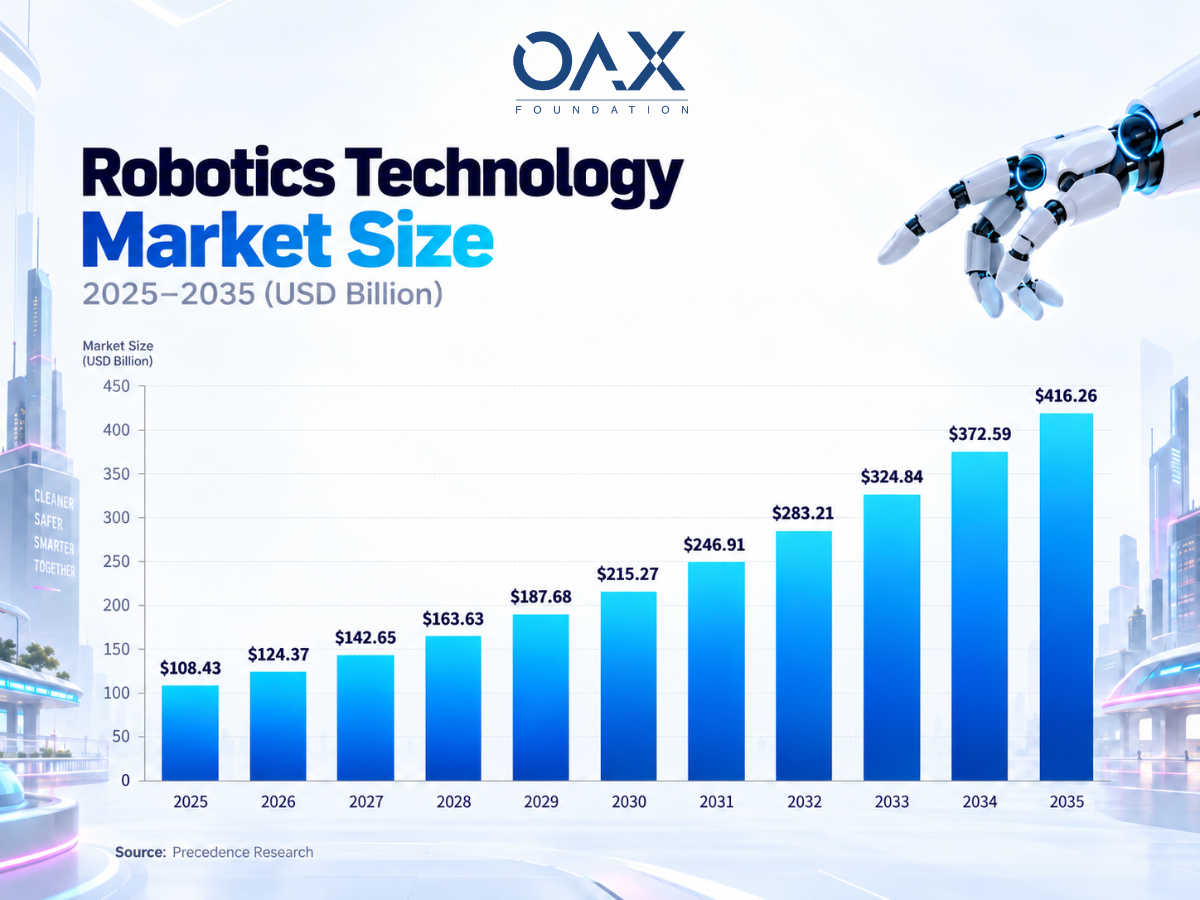
Motors, gears, batteries, cameras, sensors, hands and actuators all have to be manufactured - cheaply and at scale. According to Goldman Sachs research, hardware manufacturing costs dropped roughly 40% year-over-year, accelerating market forecasts up to $138 billion by 2035 with over 6.5 million units projected to ship globally.
That plays directly into China’s industrial strengths. China’s rapid scaling strategy is turning humanoid hardware from an expensive laboratory luxury into a mass-manufactured component.
The Role of The Greater Bay Area
If Silicon Valley leads in artificial intelligence models, China’s Greater Bay Area (GBA) is where those models get physical bodies and where embodied AI reaches commercial scale.
By pairing Hong Kong’s capital, international IP framework, and world-class university research with Shenzhen and Dongguan’s precision manufacturing, the GBA compresses hardware iteration cycles from months to days.
This supply chain proximity slashes unit costs, making high-volume fleet deployments and the massive physical datasets they generate financially viable long before Western counterparts can catch up.
We have already seen flagship players set up shop alongside a rich heritage of building robotics in this region: UBTECH Robotics: As one of the earliest humanoid pioneers listed on the HKEX, UBTECH anchored its global headquarters in Shenzhen to seamlessly connect R&D with precision hardware assembly. AI² Robotics: Representing the new wave of GBA embodied AI startups, Shenzhen-based AI² Robotics recently secured major venture funding to scale its general-purpose humanoids (AlphaBot). Through this integrated flywheel of capital, talent, and hardware speed, the GBA isn’t just participating in the global robotics race, it is setting the commercial pace.
Conclusion: How to Evaluate the Robotic Future
So, robots can dance. Can they work?
Increasingly, yes, but usefulness will arrive unevenly.
The first winners won’t be household robot butlers. They’ll be machines performing repetitive, measurable tasks in factories, warehouses, and other structured environments where ROI is immediate.
The companies that win won’t be those with the flashiest viral demos, but the ones solving the unglamorous bottlenecks: mechanical dexterity, edge-compute battery efficiency, unit costs, and real-world training data.
With its deep heritage in R&D and precision manufacturing, the Greater Bay Area anchored by industry giants like UBTECH has become the primary sourcing hub for international robotics firms like Agile Robots to procure everything from specialized gearboxes to tactile skins.
This is why the GBA occupies such a pivotal position in the global robotics race. In physical AI, intelligence is only half the product the body still has to be built. Shenzhen and Dongguan’s precision supply chains, the GBA allows hardware makers to prototype and deploy componentry at unmatched speed and scale that global tech firms rely on.
Structured factory floors will be the first environment where humanoids prove their commercial worth. A significant timeline gap remains before these machines enter consumer homes, as navigating an unstructured household requires solving complex spatial reasoning, tactile safety, and dynamic edge cases that hardware scaling alone cannot resolve overnight.
Yet, these industrial proving grounds are essential stepping stones. As manufacturing lowers unit costs and accelerates real-world fleet deployments, factories will generate the vast physical datasets needed to train smarter foundation models.
The humanoid race is real. But the benchmark isn’t whether a robot can backflip, it’s whether somebody will pay it to work.
To track how this landscape unfolds, tech readers can follow regional tech and business outlets, such as GMAsia News, which closely cover cross-border AI models, hardware supply chain shifts, and regional deployment news across Asia.
Disclaimer: The above is an opinion piece written by an authorized author, but in no way represents the official standpoint of OAX Foundation Limited, nor should it be meant to serve as investment advice.